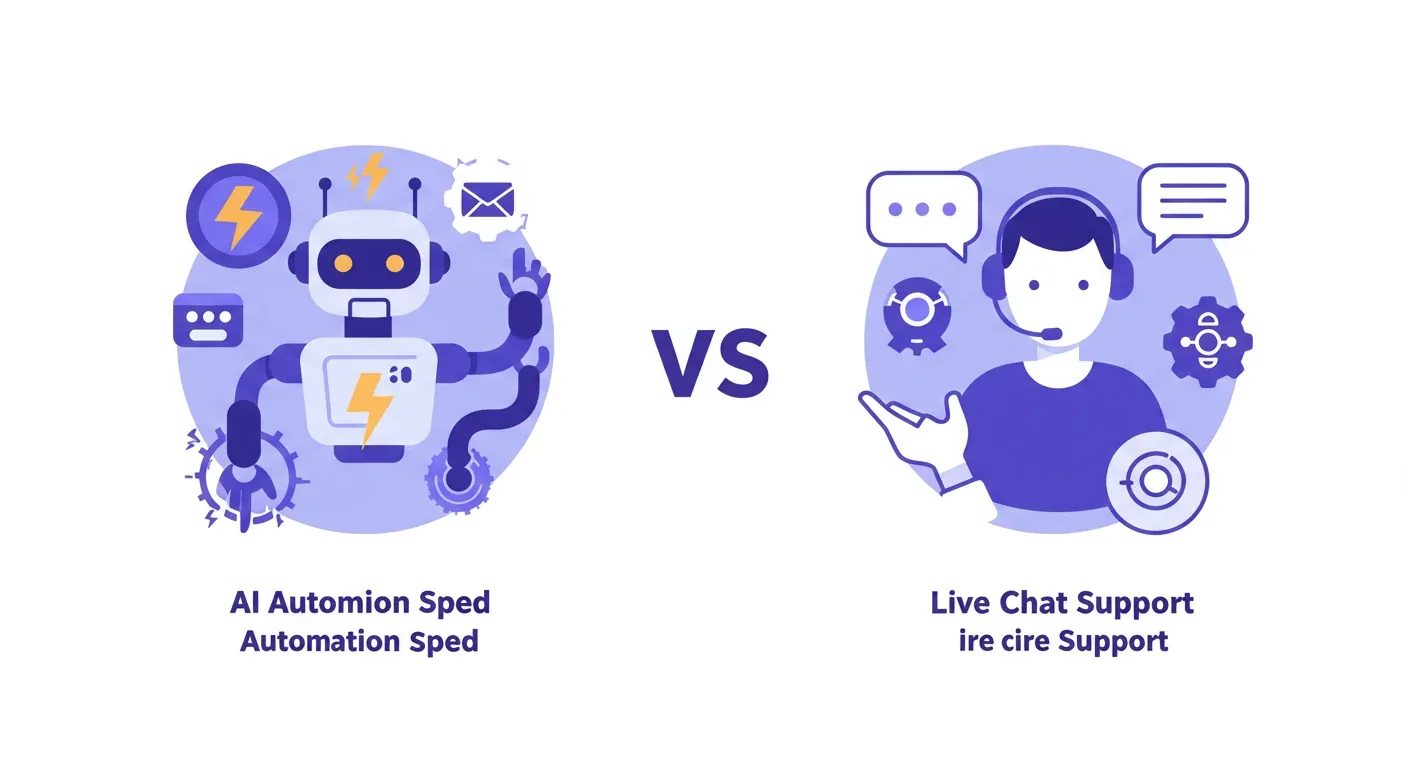
If you are weighing ai chatbot vs live chat for your website in 2025, the honest answer is that you almost certainly need both, but in different proportions than most of your competitors. AI chatbots now resolve 60-80% of routine questions on their own at a few cents per conversation, while live chat costs $5-$8 (≈₹420-₹670) per conversation once you factor in agent salary and downtime. The smart move for an SMB is to route the repetitive 80% to AI and reserve human chat for the 20% that genuinely needs a person.
This guide compares ai chatbot vs live chat across the dimensions that actually move revenue: cost per conversation, response time, after-hours coverage, accuracy on FAQs, lead capture, integrations, training overhead, scaling, and language support. We will walk through specific use cases for clinics, salons, e-commerce, and B2B services, and finish with a decision framework you can apply this afternoon. Wherever the right answer is to use both, we will show you the hybrid setup that beats either tool on its own.
The data is drawn from 2025 benchmarks (Gartner, Salesforce State of Service, Intercom Customer Service Trends, Tidio SMB report) and from what AIChatBot customers are actually shipping in production right now across the US, UK, Australia, Canada, and the EU.
What you will learn
- What is the difference between AI chatbot and live chat?
- AI chatbot vs live chat: 12-dimension comparison table
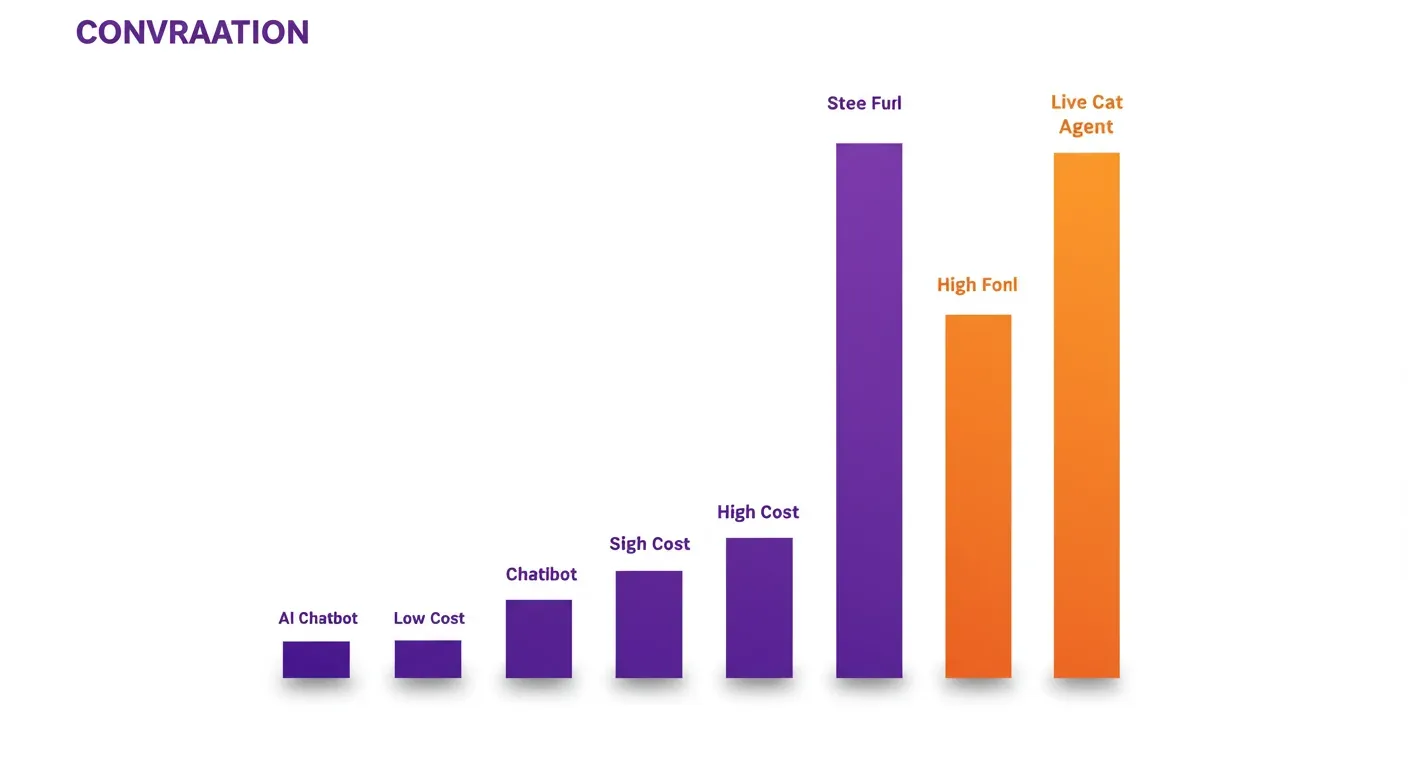
- Cost per conversation: where the real money goes
- Response time, after-hours coverage and the 24/7 question
- Accuracy on FAQs and training overhead
- Lead capture, appointments and revenue impact
- Integrations, scaling and team workflow
- When to choose an AI chatbot
- When to choose live chat
- The hybrid setup that beats both
- How AIChatBot handles AI plus human handover end-to-end
- Real-world use cases by industry
- The 5-minute decision framework
- Frequently asked questions
What is the difference between AI chatbot and live chat?
An AI chatbot is a software agent that reads incoming messages and replies using a large language model grounded in your business own content. Modern AI chatbots like AIChatBot run on a RAG knowledge base (retrieval-augmented generation). You upload your service pages, FAQs, pricing and policies, and the bot answers from that material instead of guessing.
A live chat is a real human typing replies from your team. The widget on your website routes the visitor message to an agent dashboard, the agent answers, and the conversation continues until the visitor leaves or the ticket closes.
Both look like a chat bubble in the bottom-right of your site. Behind the bubble, the economics, the coverage, and the workflow are completely different. That is what this comparison is really about.
The third option, which most 2025 winners actually run, is a hybrid widget: AI answers first, falls back to a human when the question is complex or the lead is hot, then logs the whole conversation back into the bot memory so it gets smarter the next time around. AIChatBot is built around this hybrid pattern by default.
Where AI chatbots came from
Pre-2022 chatbots were rule-based: if-this-then-that decision trees that broke the moment a customer asked a question outside the script. Anyone who lived through the era of "Press 1 for billing" web widgets remembers why people hated them.
The 2023-2025 generation is fundamentally different. Modern AI chatbots use foundation models (GPT-4-class, Claude, Gemini), grounded in your data through RAG, with structured tools they can call to book appointments, look up orders, push leads to your CRM, or send a WhatsApp message. The result feels less like a script and more like a junior team member who has read every page on your site.
Where live chat sits in 2026
Live chat has not gone away. The leading vendors (Intercom, LiveChat, Tidio, Crisp, Drift, HubSpot Chatflows) have leaned into the human-plus-AI pattern, often bolting an AI assistant onto the agent side of the conversation rather than the visitor side. Pure live-only chat is now mostly used in regulated industries, luxury sales, and small teams where conversation volume is low and personal touch is the product.
AI chatbot vs live chat: 12-dimension comparison table
The table below compares both tools across the dimensions that matter for an SMB making a real budget decision in 2025. AIChatBot is shown as the AI reference because it is built specifically for the international SMB price point and use cases.
| Dimension | AI chatbot (AIChatBot) | Live chat (human-only) | Hybrid (AI + human) |
|---|---|---|---|
| Cost per conversation | $0.03-$0.08 | $5-$8 | $0.30-$0.80 blended |
| Monthly platform cost | $29-$149 | $39-$199 per agent + salary | $59 (≈₹4,950)-$199 + part-time agent |
| Response time | Under 2 seconds | 30 seconds - 5 minutes (often longer) | Under 2s for AI, 30s for handover |
| 24/7 coverage | Always on | Only during agent shift | Always on, human within shift hours |
| Accuracy on FAQs | 85-95% (with RAG) | 90-98% (well-trained agent) | 92-98% combined |
| Handles emotional or sensitive issues | Limited - should escalate | Strong | Strong (AI escalates correctly) |
| Lead capture (after hours) | Excellent | Lost | Excellent |
| Appointment booking | Yes - calendar sync, reminders | Yes - manual | Yes, automated by AI |
| Languages supported | 50+ (English, Spanish, French, German, etc.) | Whatever your team speaks | 50+ via AI, native via human |
| Scales with traffic spikes | Linear, zero added cost | Needs more agents fast | AI absorbs the spike |
| Training overhead | 30 mins to upload docs once | Ongoing - every new agent | 30 mins for AI + agent SOP |
| WhatsApp + voice extension | Yes (WhatsApp Business AI, voice receptionist beta) | Manual, agent-driven | Yes, AI-led with handover |
Two takeaways. First, AI is roughly 80-200x cheaper per conversation than live chat once you account for blended agent cost in US/UK/AU markets. Second, the hybrid column rarely loses to either pure approach, which is why every 2025 leader runs hybrid by default.
Cost per conversation: where the real money goes
Most SMB owners look at platform pricing. The bigger number is per-conversation cost, because that is what scales when traffic grows.
Take a clinic in Austin doing 600 inquiries per month: appointment bookings, hours, location, reschedules, intake questions. With a human-only live chat at $7 per conversation, that is $4,200 per month in agent cost (after blending salary, headcount, and the platform fee). Run the same 600 conversations through AIChatBot and you are spending closer to $50. The platform fee covers it with thousands of conversations to spare.
The arithmetic is similar for a 12-store retail brand handling 4,000 monthly chats, a SaaS company with 1,200 product questions, or a real-estate firm answering 800 inbound site visitors. The first two months will not show the savings cleanly because you usually still keep your human team. What you are buying back is their time, not their headcount.
Why AI is so much cheaper per conversation
Three reasons. First, the marginal cost of an LLM call is a few cents of compute. Second, the AI does not sleep, eat, or take leave: uptime is effectively 100%. Third, AI handles parallel conversations infinitely. One human handles 2-4 simultaneous live chats at most before quality drops.
The Tidio SMB Index 2025 found that small businesses running an AI chatbot for customer service saw a median 67% reduction in repetitive ticket volume within 90 days. Those tickets did not vanish, they were resolved without a human. The team got the time back.
Where live chat is not actually expensive
Live chat is not expensive when your conversation volume is genuinely low (under 60 per month) or when each conversation is worth $1,000+ (high-ticket sales). At that scale, the agent salary is a rounding error against deal value. Anywhere in between, AI wins on unit economics.
Response time, after-hours coverage and the 24/7 question
Response time is the single biggest predictor of whether a website visitor converts. The Drift State of Conversational Marketing report (replicated in Intercom 2025 benchmark) shows that visitors who get a reply within 5 seconds are 4.7x more likely to convert than those who wait more than a minute.
AI chatbots reply in under 2 seconds, every time. Live chat reply times in 2025 average 90 seconds during business hours and stretch past 6 hours after-hours, weekends, and during holidays. For an SMB serving customers across multiple time zones, after-hours is most of the day.
The 24/7 reality for international SMBs
Roughly 35% of B2C website traffic now happens between 9 PM and 7 AM local time, driven by smartphone behavior. A US business serving Australian customers, or a UK SaaS serving North American buyers, faces this every day. Visitors who land at 11 PM expect a reply. The ones who do not get one bounce to a competitor. Live chat cannot economically cover this window. AI does it as a side effect of being AI.
For a dental practice or a salon, the after-hours capture pattern is dramatic. Customers on AIChatBot routinely report 30-45% of their booked appointments now coming from messages received after 8 PM, when the receptionist is off the clock and a human-only widget would have lost them.
Where live chat still wins on perceived speed
Inside business hours, with a small dedicated team, live chat can feel faster on emotional questions because the human can read the tone and adjust. AI catches up here when grounded with brand-voice instructions, but a well-trained human still wins on a complaint or escalation. Be honest about how often that scenario actually shows up in your inbox.
Accuracy on FAQs and training overhead
Accuracy is where rule-based chatbots got their bad reputation. The 2025 generation is much better, but it is not infallible. Knowing where the cliff edges are is what makes a deployment work.
What modern AI chatbots get right
With a properly built RAG knowledge base, AI chatbots resolve 85-95% of factual FAQs accurately. AIChatBot RAG service ingests your help center, service pages, pricing, and policies, then grounds every reply in that material. If the question maps to your content, the bot will pull the right line. The Salesforce State of Service 2025 report shows AI deflection rates rising from 24% in 2022 to 51% in 2025 across mid-market deployments.
Training overhead is dramatically lower than live chat. You upload your docs once (typically a 30-60 minute task), the embeddings are generated, and the bot is ready. Adding a new product or policy means re-uploading one document. Compare that to onboarding a new live chat agent: a week of shadowing, scripts, escalation rules, and quality reviews.
Where AI chatbots get it wrong
AI struggles when the answer is not in your content (it should say "I do not know" and the better tools do), when the question is highly emotional (the right move is escalation), or when the user is trying to negotiate a custom deal that needs human judgement. AIChatBot default escalation rule fires the moment the bot sees pricing pushback or a regulated keyword.
Live chat training overhead
Live chat accuracy can hit 95-98%, but only with a trained agent. The training cost is recurring: you train, the agent leaves in 14 months, you train again. AIChatBot knowledge base belongs to your tenant; agents come and go but the bot retains everything.
Lead capture, appointments and revenue impact
Customer service is the cost-side debate. Lead capture is the revenue-side one, and this is where AI gap over live chat opens widest.
The after-hours lead recovery problem
For service businesses (clinics, salons, agencies, consultants), 30-45% of qualified inquiries arrive outside business hours. Live chat misses them all unless you staff overnight. AIChatBot appointment booking module catches them: the bot qualifies the visitor, offers calendar slots, books the appointment with calendar sync, and sends a confirmation plus a reminder via SMS or email. The human team wakes up to a populated calendar.
Customers running AIChatBot appointment booking on a typical clinic site convert after-hours visitors at 18-25%, compared with 3-5% for the same site running a contact form alone.
Lead qualification that actually scales
Good live agents qualify well, when they have time. AIChatBot lead routing asks 3-5 qualifying questions (budget, timeline, project type, location), scores the lead, and routes hot ones into your sales team Slack channel or HubSpot in seconds. Cold leads go into a drip campaign automatically. Nothing falls through the cracks.
Compare this with a live agent who, mid-shift, has to remember to qualify, to route, to log, and to follow up. The drop-off is not the agent fault, it is the workflow.
Drip campaigns triggered by chat behavior
One feature live chat genuinely cannot match: AIChatBot drip campaign automation triggered by chat behavior. A visitor who asked about pricing but did not book gets a follow-up email two days later. A visitor who asked about a specific service gets a case study linked to that service the next morning. The bot sees the signal; the drip system fires the right message at the right time.
This is part of what we call the 4-layer product: L1 Lead Capture, L2 Lead Management, L3 Growth Automation, L4 AI Business OS. Live chat sits in L1 only. AIChatBot covers L1 to L3 by default.
Integrations, scaling and team workflow
What plugs into what, and how the whole stack scales when traffic doubles.
Native integrations to expect in 2026
An AI chatbot platform worth deploying in 2025 should integrate natively with: Google Calendar / Outlook / Calendly (for booking), Slack and email (for lead routing), HubSpot / Salesforce / Pipedrive (CRM sync), Shopify and WooCommerce (e-commerce), WhatsApp Business and Messenger (channel extension), Stripe (payment links inside chat), Mailchimp / Klaviyo / SendGrid (drip), and your CMS (RAG ingest). AIChatBot ships with all of these.
Live chat tools (Intercom, LiveChat, Tidio, HubSpot Chatflows) have similar integration breadth. The difference is that on the live chat side, the integrations support the human; on the AI side, the integrations are what the bot calls when it acts on its own.
Scaling with traffic spikes
If your site goes viral on a Friday (Black Friday sale, a press mention, a viral TikTok), your traffic might 10x overnight. AI scales linearly: 1 conversation or 10,000, the cost barely moves. Live chat hits a wall at the second concurrent conversation per agent. You either over-staff and pay through the nose or under-staff and lose the spike.
Team workflow inside the dashboard
This is where the hybrid model wins. AIChatBot ships with an agent inbox where humans can take over a conversation mid-stream, see the bot previous replies, edit memory, and hand back to AI when the issue is resolved. The team sees AI as a teammate that did the boring 80% of the work, not a replacement.
When to choose an AI chatbot
Pick AI-first when most of these match your business:
- Your monthly inbound volume is 100+ conversations
- You serve customers outside your local 9-6 window (B2C, e-commerce, multi-region service)
- You have a written body of knowledge (service pages, FAQs, policies) the bot can ground in
- Your average deal value is below $1,000
- You want to capture appointments or leads automatically
- Your team is already stretched and you do not want to hire another agent
- You want to support multiple languages without hiring multilingual staff
- You want a 30-day ROI on the platform fee
Verticals where AI-first wins overwhelmingly: clinics, dental practices, physiotherapy, fitness studios, salons and spas, online education, real estate inquiries, e-commerce stores, agencies, SaaS support. Anywhere the questions repeat, AI eats the volume.
What AIChatBot specifically gives you in this scenario
The platform launches in 5-10 minutes (paste a script tag, upload your help center to the RAG knowledge base, set a Google Calendar). Out of the box you get appointment booking with reminders, lead routing to Slack and email, WhatsApp Business AI, drip campaign automation, and 50+ language support. Pricing starts at $29 per month, billed in USD via Stripe, with annual plans available, no per-conversation surprises.
Read more about AI chatbots transforming customer support in 2025 for a wider view, or how to train your AI chatbot knowledge base for a setup walkthrough.
When to choose live chat
Pick live-only chat when most of these match:
- Your average deal value is $1,000 or higher (luxury, B2B enterprise, real-estate sales)
- Your conversation volume is below 60 per month
- Your buyers strongly prefer humans (older demographics, regulated finance, legal advisory)
- The conversations are emotional, sensitive, or carry liability (mental health, legal advice, insurance disputes, medical second opinions)
- Your differentiator is "a real human always picks up"
- You have headcount to staff a live window already
Verticals where live-only chat still wins: high-end legal practices, private wealth advisory, mental health crisis lines, high-ticket B2B sales ($25,000+ deals), bespoke jewellery, premium concierge services, and any regulated workflow where saying the wrong thing carries legal risk.
What live chat does that AI does not yet
Live chat reads tone in a way AI cannot reliably match in 2025. A human catches the difference between "why is this taking so long" (annoyance) and "why is this taking so long?? I needed it yesterday!!!" (full-blown escalation) and adjusts. AI is getting closer but is not there yet on emotionally charged conversations. Be honest with yourself about how much of your inbox looks like that.
The hybrid setup that beats both
The setup that wins for 80%+ of SMBs in 2025 is not AI vs live, it is AI-first with smart human handover.
How the hybrid actually works
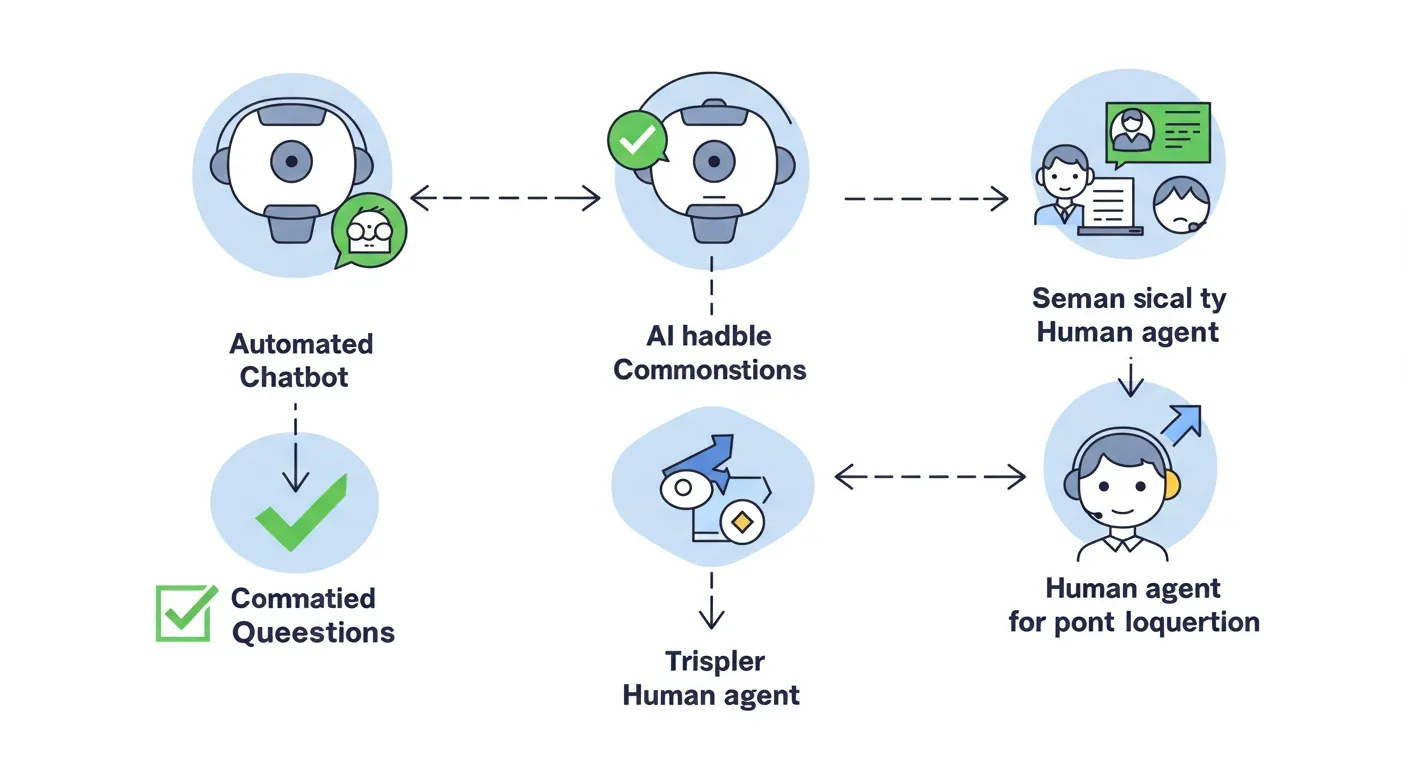
Step 1: AI greets every visitor instantly. Most go through to a resolved answer or a booked appointment without a human ever touching the conversation.
Step 2: AI escalates to a human when one of these triggers fires: visitor says "speak to a human," question is a complaint, lead score crosses your threshold, conversation contains a regulated keyword (legal, medical decision, refund dispute), or the bot detects it is hitting the limits of its knowledge base.
Step 3: Human takes over inside the AIChatBot agent inbox, sees the full conversation history, replies, and either resolves or hands back to AI for follow-up.
Step 4: Conversation is logged, lead routed, calendar updated, drip campaign queued. The next visitor with a similar question gets a smarter bot.
What the cost looks like in practice
A typical SMB running this hybrid pays $59 (≈₹4,950)-$199 per month for AIChatBot plus the salary of one part-time agent who covers business hours for the 15-25% of conversations that escalate. That is roughly one-third the cost of a full live-chat operation, with double the coverage and the same conversion rate or better.
How AIChatBot handles AI plus human handover end-to-end
Worth a section on its own because most platforms only do half of this.
Lead Capture (Layer 1)
The widget loads in under 1 second on your site, greets the visitor, qualifies, captures contact, books appointments via Google Calendar or Outlook sync, and routes to Slack or email. Conversations on WhatsApp work the same way through the WhatsApp Business AI integration.
Lead Management (Layer 2)
Every captured lead lands in the AIChatBot CRM with full conversation history, lead score, and last-touch timestamp. From there it pushes to your HubSpot, Salesforce, or Pipedrive instance via native integration. Your team sees a tidy pipeline, not a chaotic chat log.
Growth Automation (Layer 3)
Drip campaigns triggered by chat behavior. A visitor who asked about pricing gets a case-study email two days later. A booked-but-no-showed visitor gets a re-book SMS the next morning. Nothing manual; everything fired by the bot observation of the conversation.
AI Business OS (Layer 4)
The full operating layer where the bot starts to take initiative: drafting replies for your team to approve, suggesting which leads to call first, summarizing the week conversations, flagging churn risk. Layer 4 is where AI moves from tool to teammate.
Pure live chat covers Layer 1 only, and even that is partial because it cannot cover after-hours. AIChatBot covers all four layers in a single platform.
Real-world use cases by industry
Same comparison framework, applied to specific SMB verticals.
Clinics, dentists and physiotherapy
Highest-leverage use case. AIChatBot handles appointment booking with calendar sync, sends SMS reminders the night before (no-show reduction of 20-35%), captures after-hours emergency triage, and supports English, Spanish, French, German, and Mandarin out of the box. Live chat alone cannot economically cover the after-hours window. The voice AI receptionist (in beta) extends this to inbound phone calls. HIPAA-aware data handling and GDPR-compliant data residency are configured at the tenant level.
Salons, spas and beauty
Booking-heavy and reschedule-heavy. AI handles the booking, the reschedule, the "what time can I come tomorrow," and the "is this service still $85." Live chat would burn an agent on each of those. Hybrid escalates only the genuinely unusual requests: cancellations, complaints, custom packages.
E-commerce stores (Shopify, WooCommerce)
Product Q&A, abandoned cart recovery via proactive chat, order tracking, returns triage. AIChatBot connects to Shopify in 2 clicks, ingests the product catalog into RAG, and answers product questions accurately. Tidio 2025 SMB report flags abandoned-cart recovery via chatbot as a top-3 ROI driver for SMBs that adopt one.
B2B SaaS and agencies
Lead qualification, demo booking, pricing-page conversion. The bot asks the right qualifying questions, books a discovery call into the founder Calendly, and routes hot leads to Slack. Drip campaigns nurture cold leads automatically. Live chat in B2B SaaS is reserved for trial conversations and renewals, exactly where humans add the most value.
Real-estate agents and developers
High inbound volume, mostly repetitive (price, location, square footage, bedrooms, listing status). AI eats 80% of those questions. Live chat or human callback handles the genuinely interested buyers. The right setup pairs an AI receptionist on the website with a sales caller who only dials the lead score 8+ leads.
Coaching, consulting and online courses
Consult-heavy and price-sensitive. The bot pre-qualifies (budget, timeline, problem statement), books a free strategy call, and sends a calendar invite. Drip campaigns nurture the not-yet-ready leads with case studies and testimonials. The consultant time is reserved for booked calls.
Professional services (lawyers, CPAs, accountants)
Mixed bag. AI handles intake, scheduling, FAQs ("do you do business tax filings," "what is your hourly rate"). Live chat or call handles actual advisory. Be careful with regulated advice. Set the bot to escalate any specific legal or tax question to a human.
The 5-minute decision framework
Walk through these five questions in order and the answer drops out.
- Volume: Are you handling 100+ chats per month? If yes, AI-first. If no, live chat is fine.
- Hours: Do customers contact you outside your 9-6 window? If yes, AI must be in the mix.
- Deal value: Is your average deal size below $1,000? If yes, AI-first. If above $1,000, hybrid with strong human escalation.
- Repeatability: Are 60%+ of your questions repeats (hours, location, pricing, booking)? If yes, AI is mandatory.
- Trust: Is your differentiator "a real human always answers"? If yes, live-only. Otherwise hybrid.
For 80% of SMBs, this lands on AI-first hybrid. For high-ticket regulated specialists, it lands on live with AI helping the agent. For solo operators with very low volume, almost anything works; AIChatBot still gives you 24/7 coverage at the price of a phone bill.
Common objections and what is actually true
The pushback we hear most often, with honest answers.
"My customers will hate talking to a bot"
True if the bot is bad. Modern RAG-grounded AI replies feel like a knowledgeable junior team member, and the option to say "speak to a human" is always one click away in AIChatBot. The 2025 Salesforce survey shows 64% of consumers prefer self-service for routine questions if the self-service actually works. The new objection is bad self-service, not self-service itself.
"AI will hallucinate and damage my brand"
Real risk if you deploy a generic LLM with no grounding. Mitigated by RAG (the bot only answers from your uploaded content), strict guardrails (refuse to discuss topics outside your business), and conservative escalation rules (any pricing or refund question goes to a human). AIChatBot ships with these defaults.
"Setup will take weeks"
It used to. AIChatBot deploys in 5-10 minutes for a basic widget, plus an extra 30-60 minutes if you want to upload your help center and set up appointment booking. Most customers are live the same day they sign up.
"I will lose the personal touch"
You will lose the personal touch on the boring 80% of conversations. You will gain the time to deliver a better personal touch on the 20% that matters. That is the trade you are making, and it is almost always the right one.
Verdict: which is right for your business?
For most SMBs, the right answer is AI-first hybrid running on AIChatBot. You get the cost economics of AI, the coverage of 24/7, the lead capture of an automated funnel, and the human touch where it matters: escalations, complaints, high-stakes sales, through the agent inbox.
For high-ticket regulated specialists or businesses where "a real human always picks up" is the brand promise, lean live-only with AI assisting on the agent side. For solo operators with very low volume, almost anything works; AIChatBot still gives you 24/7 coverage at the price of a phone bill.
The myth was that you had to pick one. The reality in 2025 is that the AI chatbot vs live chat debate has been replaced by AI-first plus human escalation. The brands winning their categories are running this hybrid; the ones losing are still defending one side of the wall.
Frequently asked questions
Is an AI chatbot better than live chat for small businesses?
For most SMBs running 1-50 staff, an AI chatbot is the better primary channel because it handles 60-80% of repetitive questions 24/7 at a few cents per conversation, captures leads after hours, and books appointments while you sleep. Live chat still wins for high-stakes, emotional, or complex sales conversations. The real winner is a hybrid: AI handles the volume, the human handles escalations. Solo founders and lean teams should start with AI-first, add a 2-hour human window for hot leads, and grow from there.
How much does an AI chatbot cost compared to live chat?
AI chatbots cost $29-$149 per month for a typical SMB on platforms like AIChatBot, with no per-conversation cap. Live chat tools like Intercom, LiveChat, or Tidio sit at $39-$199 per agent per month, plus the salary of the agent ($3,000-$5,000 monthly in the US/UK/AU). On a per-conversation basis, AI handles questions at roughly 3-8 cents each, while live chat works out closer to $5-$8 (≈₹420-₹670) per conversation once you include agent salary, downtime, and training.
Will an AI chatbot replace my customer support team?
No, and you should not want it to. AI chatbots handle the repetitive 80% of inquiries (pricing, hours, location, simple bookings, order tracking, FAQs) so your team can focus on the 20% that actually drives revenue: complex sales, escalations, complaints, retention calls. SMBs that use AI to augment their team typically free up 20-30 hours of agent time per week and reinvest it in higher-value work. The team gets more leverage, not less.
When should I choose live chat over an AI chatbot?
Choose live-only chat when your average deal value is high ($1,000+), conversations are emotional or sensitive (legal, mental health, insurance claims), your visitors strongly prefer humans (luxury, B2B enterprise, regulated finance), or your daily volume is so low that automation is overkill. For everyone else, AI-first with human escalation wins on cost and coverage.
Can AI chatbots really book appointments and qualify leads?
Yes, this is one of the strongest 2025 use cases. AIChatBot appointment booking syncs to your Google Calendar, Outlook, or Calendly, sends SMS and email reminders, and handles reschedules without a human ever touching it. For lead qualification, the bot asks a short set of qualifying questions (budget, timeline, project type), scores the lead, and routes hot ones to your sales team Slack or HubSpot in seconds. SMBs running this setup typically see 30-50% more booked appointments per month.
What about messaging channels - does AI chatbot or live chat handle them better?
AI handles messaging at scale better because customers expect a reply within minutes on WhatsApp, Messenger, and SMS, including evenings and weekends. AIChatBot WhatsApp Business AI integration answers product questions, books appointments, and qualifies leads automatically, then hands off to a human only when needed. A live-only messaging setup forces someone to monitor every channel through evenings, weekends, and time zones, which is exactly the work AI was built to remove.
How long does it take to set up an AI chatbot vs live chat?
AIChatBot deploys in roughly 5-10 minutes - paste a script tag, upload your help docs to the RAG knowledge base, set your booking calendar, you are live. Live chat is faster to install (a single tag) but slower to operationalize: you need agent rotas, training scripts, escalation rules, and someone to actually be online during your stated hours. AI is set-and-forget on the repetitive layer; live chat is a recurring people-ops commitment.
See AIChatBot running on your business - free personalized demo
The fastest way to know if AI-first hybrid will work for your specific business is to see it running with your branding, your services, and your tone, not a generic showcase. AIChatBot DemoBuilderService spins up a personalized demo website with your brand, service list, and example conversations in under 10 minutes.
You can play with it, share it with your team, see the appointment booking, the lead routing, the drip campaigns, and the WhatsApp Business integration on your own domain mock-up before you decide.
For more reading, see our AI chatbot pricing guide for 2025, our deep-dive on training your AI chatbot knowledge base, and our guide to AI chatbots transforming customer support in 2025.